
Gilead
Part of the 33 Essential Reads

Above the gate to Hell in Dante’s Inferno is a foreboding inscription which says Lasciate ogne speranza, voi ch’intrate (Abandon all hope, ye who enter here). Keeping that in mind, I created a bold sign that I placed in the transom window above my classroom door which read Abbracciate ogni speranza, voi che qui entrate. Without exception, in every class someone would see the sign and ask what it means. That would allow me to tell the story of Dante’s Inferno and explain that my sign reads “Embrace all hope, ye who enter here.” Words mean things.
By my name plate next to the door, on two different walls in the classroom, and on the introductory slide for every presentation/lecture I give for every class, I have my personal mission statement listed: “Cultivating communities of acceptance and learning since 1987.” The word cultivating is chosen purposefully. Cultivating is not just planting, it is preparing and planting and nourishing and “weeding” — it’s a journey, not an event. Being a community is what we are all about. Learning is best done as a social construct. Our classroom is not a competition, it is a place where we learn together, we are a learning community. Acceptance refers to the fact that I teach everyone in the room, whatever the situation may be. I am only successful in my work if all students grow intellectually and socio-emotionally. In order for me to help you grow, I must accept you as you are. Do not misunderstand me here, acceptance does not mean tolerating harmful behavior. But it does mean that, no matter what, I will not give up on you. And finally learning is what we are all about in my class. Please look at the term learning broadly, I mean much more than just about some particular lesson. I take the time to explain all of this to all of my classes — and I remind them of it frequently. Words mean things.
When were you at your best? Was it when your team won some big game? The year you won an award? Perhaps it was the semester you earned straight “A’s.” The problem with all of these answers is that it raises the question: If that was your best, what about now? As a teacher, my current students not only demand but also deserve to have me at my very best. It could not possibly matter less to them, some award I received ten years prior. Instead, I am going to advocate for an attitude of continual improvement. No matter the class, no matter the job, no matter the situation, strive to learn and grow and improve. The key to continual improvement is to adopt and develop a philosophy of lifelong learning. Lifelong learning is the ongoing, voluntary, and self-motivated pursuit of knowledge for either personal or professional reasons. It is important for an individual’s competitiveness and employability, but also enhances social inclusion, active citizenship, and personal development.
That was my life as a teacher. It is something I spent almost 40 years doing. Teaching was not just my vocation it was my avocation. It was a labor of love. In my long career I taught history, sociology, government, geography, economics, language arts - I even taught math and science to 8th graders. But so much of my teaching went way beyond the particular subject, I tried to make it about the joy of learning, the thrill of understanding how divergent things are actually connected.
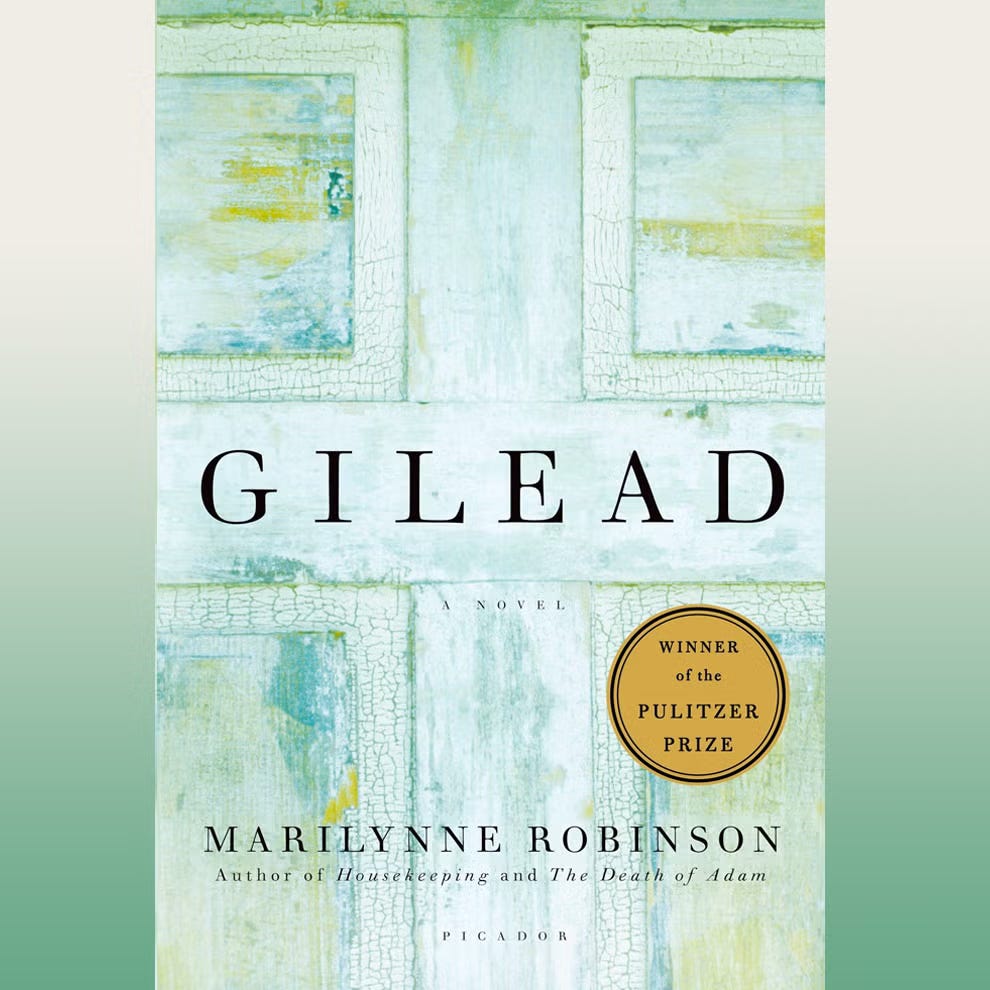
Thinking about this reflection of life and connection with those we encounter leads me to the next book on the list of 33 Essential Reads for my granddaughters. Gilead by Marilynne Robinson, published in 2004, is a meditative novel exploring faith, mortality, and the beauty of ordinary life through the letters of an aging minister, John Ames, to his young son. Key themes include the intersection of faith and daily life, the weight of family legacy
In 1956, toward the end of Reverend John Ames’s life, he begins a letter to his young son, an account of himself and his forebears. Ames is the son of an Iowan preacher and the grandson of a minister who, as a young man in Maine, saw a vision of Christ bound in chains and came west to Kansas to fight for abolition: He “preached men into the Civil War,” then, at age fifty, became a chaplain in the Union Army, losing his right eye in battle. Reverend Ames writes to his son about the tension between his father--an ardent pacifist--and his grandfather, whose pistol and bloody shirts, concealed in an army blanket, may be relics from the fight between the abolitionists and those settlers who wanted to vote Kansas into the union as a slave state. And he tells a story of the sacred bonds between fathers and sons, which are tested in his tender and strained relationship with his namesake, John Ames Boughton, his best friend’s wayward son.
The story explores themes of grace, reconciliation, the complexities of human relationships, the weight of family legacy, and the often challenging, and sometimes incomprehensible bond between fathers and sons across generations. The truth be told, my gentle readers, it is because of Gilead that I began this process of first compiling a list of books I want my granddaughters to read and then writing about each book. Each of these entries is like a letter to my granddaughters, and because they are only a little over one year old, they will not be able to read for many years.
Continuing this theme of epistolary writing - especially as a way for my baby granddaughters to know and understand me better - I will conclude with excerpts of letters written to me from my students over the years. One of my early mentors in education was an assistant principal named Roger. He was a magnificent teacher and really stressed the necessity of lifelong learning. He encouraged me to keep a “Parrott folder,” a place where I could keep the various cards, notes, and letters students would give me. Thankfully, I followed Roger’s sage wisdom. The following are snippets from a few of the many cards and letters I have received from students and have kept all these years. I hope they provide some glimpse into who I was as a teacher. And if you are reading this and are currently a teacher or considering becoming one, please know that receiving letters like the following are priceless.
“I’d like to thank you for the last two years. You’ve helped me a lot in becoming the person I am. Two years ago, I was struggling a lot. Now, I’m over a year clean of self-harm. Talking to you, getting your support and advice has been borderline life saving.”
“You noticed all my effort to succeed and I can’t say thank you enough. Some nights my own parents didn’t see all I did and neglected my efforts. You saw, though.”
“I want you to know that I want to be a teacher, and I will strive to have the impact that you have made on students.”
“Thank you for being a significant part of my exchange year in America. I have never met a teacher who cares more about the education of students than you do. I really appreciate your willingness to help people become smarter and reach their potential.”
“I cannot adequately say thank you for all the life lessons you have taught me, because to do that I would have to write a book. I thank you for listening to the ignorant and unaware girl in your class, willingly taking the time to answer my constant barrage of questions about things I didn’t understand. Playing card games with me, because you knew it was a way to get me to talk about what was bothering me. Thank you for putting up with my stubborness, and fox trot I did so easily around questions that pained me. Teaching me everything you have, when you had no obligation to do so. Lending out your books to me the summer before my senior year, without the promise of their return. Making it your goal to make me laugh out loud every day, because doing so would make it a successful day. Thank you for teaching me about the world, when I had no better example. Showing me that it’s ok to grieve, that my emotions will not be the death of me. That I am not broken because of my father’s absence, but still mending”
“As I reach the end of my high school years, I want to thank you for everything you’ve done for me in the last four years. You are someone whom I could always depend on, and someone who would listen when I needed to talk.”
“I am writing this letter to say thank you. I have learned so much not only about the world but about who I am - who I want to be. I was glad I got to spend my last year in your classroom. A classroom that was full of fart jokes and important conversations. You also inspire me to teach and learn from others, too.”
“Thank you for always believing in me and being proud of me, especially when I told you I got accepted to the University of Iowa, and that I am going to be a teacher. I want to make an impact on someone’s life because of you.”
“Thank you for actually believing that everyone is capable of getting good grades, because most teachers don’t.”
“Lately, I’ve been having a hard time in so many things and I’ve realized that you’ve been there for me. You are a true teacher. I am pretty sure people don’t often get teachers who really care about them. I appreciate your benevolence.”
“Junior year was a rough year for me. My home life was falling apart and I was not able to save it. Instead, I ran from it. I ran from the man who plastered bruises on my mother’s face.I ended up running from my mom when she needed me most. That was until you showed me the truth. You supported me when no one else really understood, you showed me how to forgive and move forward with my life.”
“The interest you take in your students is not only admirable but also honorable. You helped me understand the importance of education.”
“I just wanted to thank you for making a positive impact on my high school career. You taught me lessons that go deeper than history. You helped me believe that I have the potential to do great things in my life. You are the only teacher that called me smart. Anytime I am struggling with learning a new concept, I always remember you telling me that.”
“I love walking into your class everyday and being overwhelmingly excited about what we are learning. Thank you for pushing me to think differently, question things, and see the world from a different perspective. Your positive attitude and constant encouragement is something we need more of.”
And even after I stopped being a full time teacher and only worked as a substitute teacher, I was blessed to hear from some students:
“Mr. Parrott, you were such a great sub. Most subs just do what the teacher wrote down, but you did a lot more. You actually taught and went deep into the subject. When we were disobeying, you patiently waited and were very kind. I hope we can have you again sometime.”
And finally, I leave you with this poem a student wrote for me as the day of her graduation approached:
I promise you this,
That I will hold on to hope.
To live for love and live for me.
I promise to be thick skinned,
And unchained to the reality
That others force upon me.
I promise to lift up others
As I hold myself up.
I promise to never settle,
And to find comfort in loneliness
While still knowing I am not alone.
I promise to live
And to feel alive while doing so.
I promise to make mistakes,
And to enjoy the bad times
As much as I do the good.
I promise to remember
That pain is temporary.
And to stand up, unwavering,
For what I believe in.
I promise to let what I fear
Drive me to do great things.
And that whatever I do
I will do with great power.
I promise to let my light shine,
And to always find the light in others.
I promise you that.
And if I am to break these promises
I’ll be a fool.
But even a fool can laugh, cry, and smile
At the life given to them.
Because reality is our perception of it,
And life is priceless.
Pursuit of Knowledge is a reader-supported publication. If you’ve found this essay useful and thought-provoking, please consider a one-time donation or becoming a paid subscriber. Your support means a great deal and makes it possible for me to dedicate more time to in-depth essays on philosophy, sociology, literature, leadership, and history.
A very intimate letter with feelings straight away poured from the soul. Appreciate you giving us a glimpse of that.