
The Sun Also Rises

In American society happiness has been declining for more than 30 years.
Happiness and unhappiness are not opposites. They are actually produced in different parts of the brain, positive and negative emotions are produced with different organs in the limbic system for different reasons. Unhappiness is not the absence of happiness. We needed both in order to ascertain threats and opportunities in the ancestral environment.
What we find is that positive emotion as understood and experienced over the long term in American life has been declining. We’ve been getting less happy since about 1990. Within this degradation of the happiness climate, there have been some storms - significant downward spikes. There have been three of these storms in the 21st century. The first was 2008-2009 which marked the beginning of the proliferation of smart phones and the corresponding use of social media apps. This produced a huge downdraft in happiness. There are lots of neurophysiological reasons for that, including a change in the biology of our brains.
The second storm was ideological polarization - this climate of “I hate you if you disagree with me politically” - and the media establishment complex that’s feeding it. That is pure monetization of the American people, it is conscription into a culture war, where somebody else is profiting, not us. That’s what led to cancel culture. That’s what led to safe spaces on college campuses. That’s what led to radical activism on both the right and the left in this country, which is significantly degrading our quality of life.
The third storm was Covid. The problem wasn’t the coronavirus, per se. It was our reaction to the coronavirus where everybody went home and stayed home, even working from home. We started technologically mediating our relationships in radical fashion, which ratcheted up anxiety and depression and they never came back down.
The net result is that our society is a mess with respect to happiness that’s low and unhappiness that’s high. But it is a complicated picture. These storms, with their corresponding rising of unhappiness levels, did not start the cultural climate problem. The beginning can be found in a lowering of happiness levels.
There are four pillars of the happiest life that started to go into decline at the end of the 20th century. Research has consistently shown that the happiest people do four things regularly:
They practice their faith.
They are close to their families.
They have real friends.
They get meaning from their work, earning their success, creating value and serving people.
All four went into serious decline in the latter part of the 20th century.
People were less and less likely to practice their faith. They were less likely to get married and start families. They were more likely to have schisms with their families of origin - often over things like politics. People were getting lonelier and lonelier, and that’s accelerated when people don’t have real friends. People’s relationship with work changed. We are now much less likely to have a sense of a calling regarding our work.
So how have we typically coped with this decline in happiness? Americans mask deep-seated disillusionment and unhappiness through intense consumerism, digital escapism via social media, and a reliance on nostalgia. This emotional masking is driven by political polarization, social isolation, and economic anxiety, leading to a reliance on “dopamine hits” like endless shopping, binge-watching, and substance use to maintain a sense of normalcy.
Americans often mask discontent by buying new products or using entertainment (movies, streaming) as a distraction. This creates a “loop of needing this hit” to feel okay, serving as a distraction from deeper issues. Platforms like Instagram and TikTok are used to curate a perfect, happier life, masking loneliness or anxiety. This digital world provides a “built-in distance” that masks the pain of social isolation. As the present feels uncertain, many retreat into an idealized, romanticized version of the past, acting as a, “defense mechanism” against an overwhelming present. Political animosity is often used to channel frustration, where constant engagement in “us versus them” narratives masks personal weariness. This collective “mask” often slips, revealing high anxiety and unhappiness, particularly as the American Dream feels increasingly out of reach.
The kind of introspection and reflection needed to correct many of these problems can be extremely difficult to develop. We all tend to have a blindspot regarding our destructive or negative behaviors. Mitigating our actions is much more likely than accountability. Additionally, recency bias has always been a very powerful phenomenon. Recency bias is a cognitive bias where people overemphasize recent events, information, technologies or experiences over historical, long-term data when making decisions or forming opinions. It is a memory-based fallacy that leads us to believe recent events are more important, that new technologies are always better. These all work together to make any kind of critical examination of our culture - one that doesn’t involve simply pointing accusing fingers at others - very difficult to achieve. Once again, literature can help in this quest.
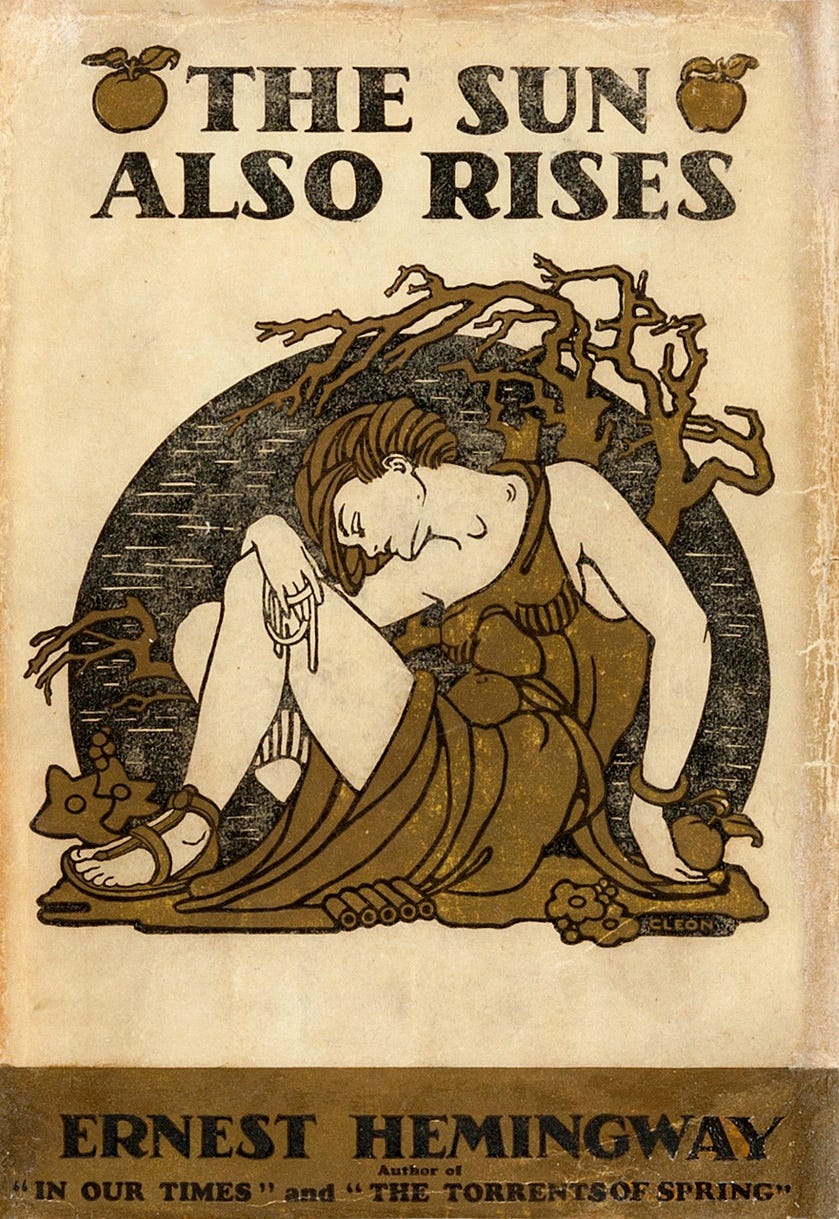
The Sun Also Rises, Ernest Hemingway’s first novel (1926), follows a group of disillusioned American and British expatriates in post-World War I Europe, chronicling their aimless journey from Paris to Pamplona, Spain, for the Festival of San Fermín. The story centers on the hopeless love between war-wounded journalist Jake Barnes and the independent Lady Brett Ashley, exploring themes of the “Lost Generation,” disillusionment, and moral decay through their hedonistic lifestyle and the intense world of bullfighting. It is considered a masterpiece that cemented Hemingway’s literary reputation.
This book explores alienation, spiritual dissolution, lost illusions, and the search for meaning in a post-war world. Narrator Jake Barnes, a journalist rendered impotent by a war injury, loves the free-spirited, enigmatic Lady Brett Ashley. They and their friends travel, drink, and watch bullfights in Spain, searching for distraction to mask their profound unhappiness.
The Sun Also Rises allows us to explore the disillusionment of the “Lost Generation,” and from there ask the most important question: What does this mean for us, today? We feel profound alienation. We feel spiritual disillusionment. Though not necessarily from war injuries, many of us feel impotent in our world. We most certainly mask our profound unhappiness. Recognizing a problem is the crucial first step to solving it, because it allows for defining, analyzing, and addressing the root cause rather than just symptoms. “We have met the enemy and he is us” is a famous phrase coined by cartoonist Walt Kelly for a 1970 Earth Day poster featuring his comic strip character, Pogo. It is a parody of a 1813 victory message, meaning that mankind is often the cause of its own problems. Literature can help us break down the walls which prevent us from understanding this truth.
Pursuit of Knowledge is a reader-supported publication. If you’ve found this essay useful and thought-provoking, please consider a one-time donation or becoming a paid subscriber. Your support means a great deal and makes it possible for me to dedicate more time to in-depth essays on philosophy, sociology, literature, leadership, and history.